




CAR T-cell therapy is a personalised immunotherapy, where a patient's own white blood cells (T cells) are removed from the body and then genetically engineered in a laboratory to express a receptor that targets a specific cancer antigen. Once infused back into the patient, CAR T cells will search out and kill the target cancer cells
KMCAR™ T-cell is HaemaLogiX’s second lead-immunotherapy. KMCAR™ T-cell, is an innovative cell therapy, designed for separate subsets of multiple myeloma patients to KappaMab™, who have become resistant to standard treatments. KMCAR™ T-cell therapy harnesses the patient’s own T cells (T cells are a type of immune cell) and genetically modifies them to recognise and destroy cancerous plasma cells that express KMA.
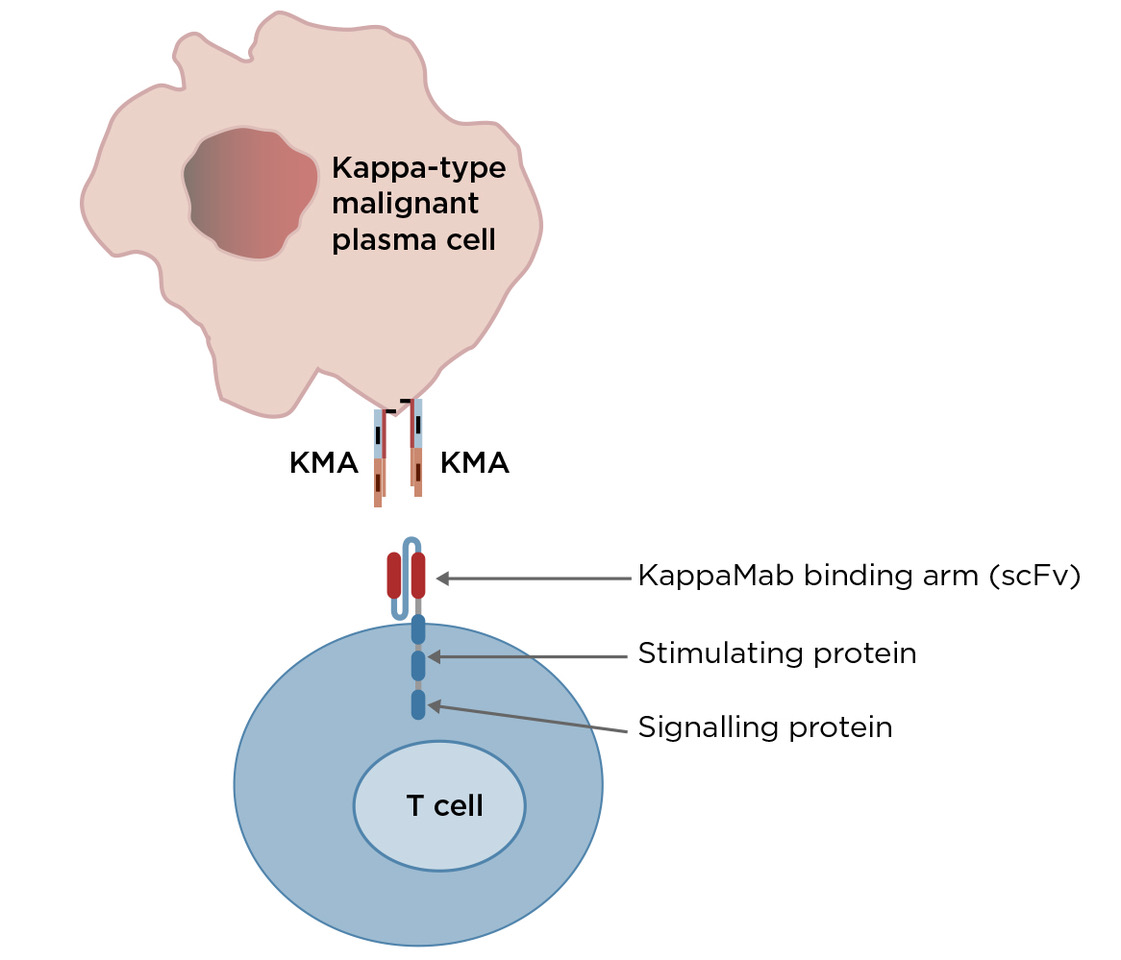
HaemaLogiX, in collaboration with clinical researchers at the Westmead Institute of Medical Research, NSW, Australia, created the KMCAR T-cell by genetically engineering T cells so that the binding arm or “single chain variable region fragment”; (scFv) of KappaMab™ is expressed and presented on the surface of the T cell. As shown in the figure below, the binding arm of KappaMab™ is connected to two proteins inside the T cell that are capable of stimulating and signalling to the T cell that it should destroy the KMA-positive myeloma cell.
In the treatment of multiple myeloma patients, the T cells are harvested from the patient’s blood and then genetically engineered in the laboratory to create KMCAR™ T-cells. These cells will then be grown and expanded to create millions of KMCAR™ T-cells, which are infused back into the patient as a “living drug”. CAR-T cells hunt down, bind to and directly kill the myeloma cells that express the relevant target. They survive in the patient’s body and continue to destroy any myeloma cells as they multiply.
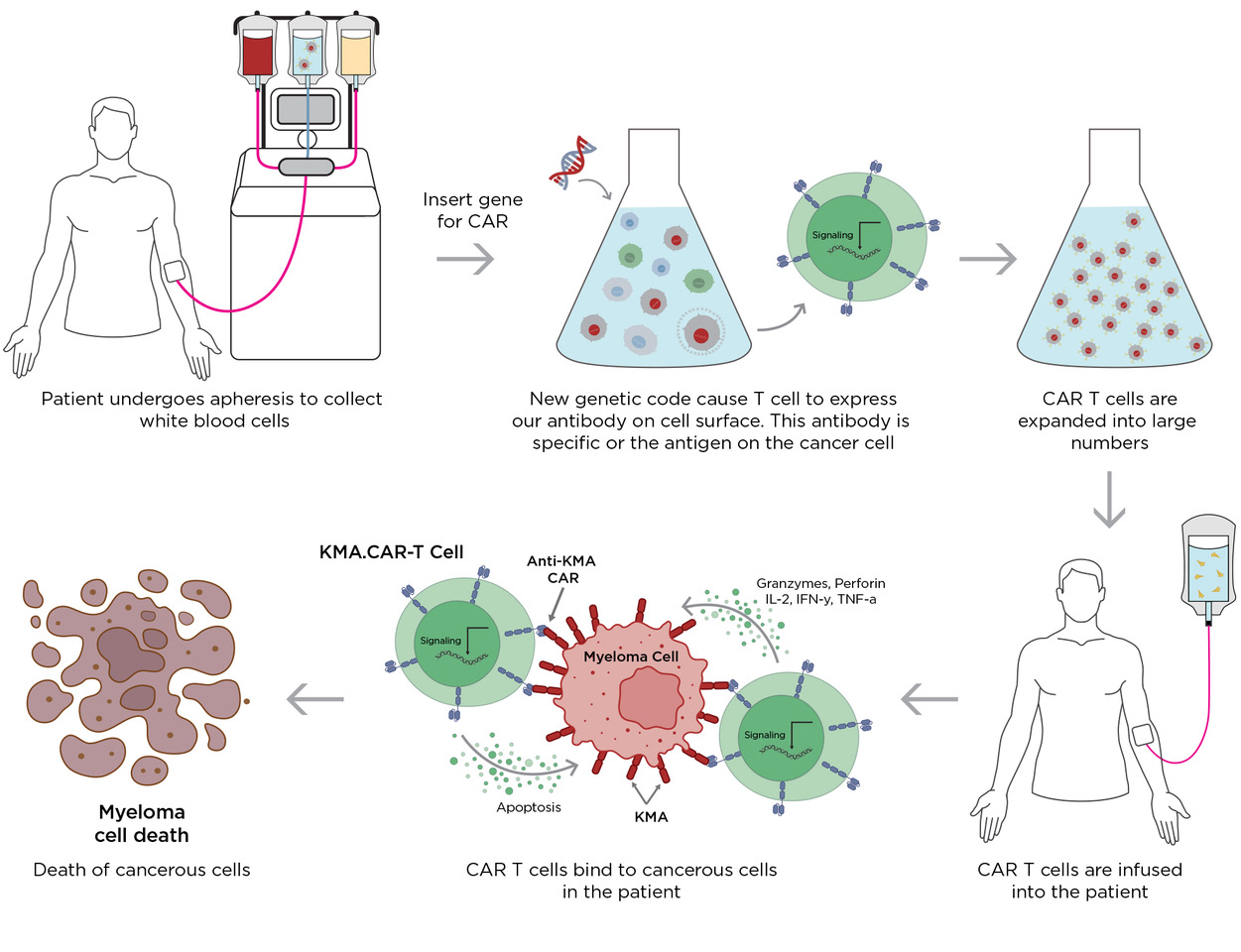
The Company's pre-clinical studies using KMCAR™ T-cell in multiple myeloma animal models showed specific and durable KMA tumour cell killing when compared to the negative control. This data has led to the Company initiating a Phase 1 clinical trial in multiple myeloma patients who have failed standard-of-care treatments.
LMCAR™ is in research and discovery phase for lambda type myeloma.
A monoclonal antibody like KappaMab™ is an infused protein that flags cancer cells for the patient's existing immune system. A CAR-T therapy like KMCAR™ takes the patient's own T cells, engineers them to recognise a target (here, KMA) and reinfuses them as a living drug. Antibodies require ongoing dosing; CAR-T is personalised, manufactured per patient, and aims for deep responses from a single infusion.
Abecma® and Carvykti® are approved BCMA-directed CAR-T therapies for relapsed/refractory myeloma and have produced deep responses in heavily pre-treated patients. KMCAR™ is HaemaLogiX's investigational CAR-T targeting the Kappa Myeloma Antigen, expressed on malignant kappa-restricted plasma cells but not healthy ones. The KOALA Phase 1 trial is designed to evaluate the safety, manufacturing feasibility and preliminary efficacy of this approach.