



Monoclonal antibodies (mAbs) have two antigen binding regions and one constant region that other immune cells, such as natural killer (NK) cells, can attach to and kill the cancer cell that the antibody is bound to. When our mAbs are infused into a person, the two antigen binding regions attach to specific antigens on the target cells (the cancer cells) in the body. Once this binding occurs, a natural killer (NK) cell from the immune system binds to the constant region of the antibody. This binding activates the NK cell, which results in killing of the cancer cell.
HaemaLogiX's monoclonal antibodies do not bind to normal, healthy immune cells called plasma cells, thus leaving them unharmed and able to function normally.
To kill myeloma cells, HaemaLogiX is developing proprietary monoclonal antibodies KappaMab™ (for patients with kappa-type multiple myeloma) and LambdaMab™ (for patients with lambda-type multiple myeloma).
Several drugs that are currently in use to help treat multiple myeloma can be used in combination with KappaMab™ and LambdaMab™ to help make them more effective at killing the cancer cells. Giving a patient an immunomodulatory drug (IMiD), such as lenalidomide or pomalidomide will make the cancer cell express more of our target antigen (either KMA or LMA) on its cell surface.
Hence, when our antibodies are infused into the patient, the cancer cell now has a much greater number of target antigens for our antibodies to bind to. This makes our antibodies much more effective at attaching to the cancer cell and recruiting the NK cells to kill the cancer cells. This increase in antigen number following pre-treatment with an IMiD is a mechanism that should increase the efficacy of our antibodies in the treatment of myeloma.
HaemaLogix’s pre-clinical studies showed that KappaMab™ binds to malignant plasma cells but not to normal plasma cells.
The Phase 1 and 2a studies were conducted in patients who had received two or more lines of treatment and had persistent, stable disease. A Phase 2b clinical trial was conducted in combination with Revlimid® and dexamethasone in relapsed and refractory myeloma (RRMM) patients with progressive disease. Together, the studies have demonstrated KappaMab’s specificity, efficacy and safety.
Recent Phase 2b clinical trial outcomes
HaemaLogiX recently completed a Phase 2b trial of KappaMab™ in multiple myeloma patients which was led by Professor Andrew Spencer at the Alfred Hospital in Melbourne.
Next Phase 2b trial – start-up underway
The Company has initiated the start-up activities for a further Phase 2b clinical trial for KappaMab™ in combination with pomalidomide and dexamethasone at an increased KappaMab dose, in patients who have failed three classes of standard-of-care drugs.
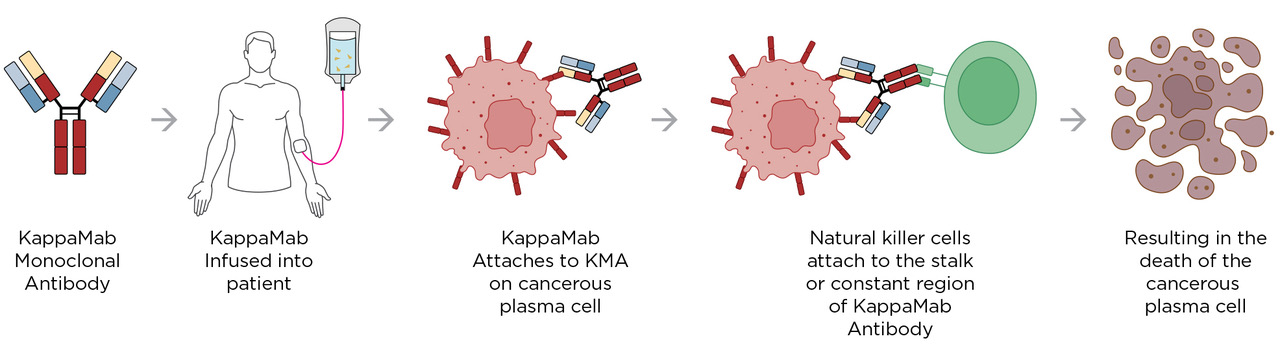
KappaMab™ is a monoclonal antibody that binds the Kappa Myeloma Antigen on malignant plasma cells. Once bound, it recruits the patient's own immune system through two mechanisms — antibody-dependent cellular cytotoxicity (ADCC), in which natural killer cells lyse the target, and antibody-dependent cellular phagocytosis (ADCP), in which macrophages engulf it. Because KMA is absent from healthy plasma cells, KappaMab™ is designed to leave the normal immune system intact.
Yes. Beyond direct antibody-mediated killing via ADCC and ADCP, published translational studies indicate KappaMab™ also remodels the bone-marrow immune environment — suppressing pro-survival signalling molecules myeloma depends on, restoring dendritic-cell function and driving expansion of cytotoxic T cells. This multi-layered activity is described in Spencer et al. (Blood Cancer Journal, 2019) and Norton et al. (Clinical & Translational Immunology, 2023).
In the Phase I study, a single KappaMab™ infusion produced dose-dependent reductions in six pro-survival signalling molecules myeloma relies on (CXCL9, CXCL10, MIF, HGF, CCL27 and G-CSF), with no rise in inflammatory cytokines and no immune-complex formation (Spencer et al., Blood Cancer Journal, 2019). By dampening these signals, KappaMab™ appears to disrupt the niche myeloma depends on.
Evidence from the Phase IIb study, combining KappaMab™ with lenalidomide and dexamethasone, suggests so. Mass-cytometry profiling of patients' bone marrow showed a shift toward a more active immune state — more activated dendritic cells and progressive expansion of cytotoxic T cells across cycles (Norton et al., 2023). These findings come from a small cohort and are being explored further.
Most myeloma antibodies — such as daratumumab (anti-CD38) and elotuzumab (anti-SLAMF7) — work mainly by flagging cancer cells for immune-mediated killing. HaemaLogiX's translational data suggest KappaMab™ acts more broadly: direct killing, disruption of the pro-survival cytokine niche, dendritic-cell reactivation and cytotoxic T-cell expansion (Spencer et al., 2019; Norton et al., 2023).
Daratumumab (Darzalex®) and isatuximab (Sarclisa®) are effective anti-CD38 antibodies and a backbone of myeloma treatment, but CD38 is expressed on both malignant and healthy plasma cells and other immune cells. KappaMab™ targets the Kappa Myeloma Antigen, restricted to malignant kappa-restricted plasma cells. HaemaLogiX's program is designed to evaluate whether this more selective profile translates into clinical benefit.